
Why anatomy is the wrong place to start
Drawing figures from imagination is hard enough.
But most of us, myself included, make it much harder than it needs to be.
We don’t just want to draw figures from imagination.
We want them to feel real. Solid. Believable.
So we jump straight into anatomy.
Muscles. Attachments. Names.
As if we’re expected to memorise the entire human body before we understand how a figure even stands, twists, or leans in space.
No wonder we freeze.
It’s like trying to build a house by starting with the interior decoration - without checking whether the structure underneath actually holds.
Why Anatomy Feels Impossible
The problem isn’t discipline, talent, or motivation.
The problem is complexity - too early.
Every time you try to draw a figure and think
“Wait… where does that muscle attach again?”
your brain hits the emergency brake and feels stressed.
At the same time, you’re already trying to:
invent a pose
deal with perspective
control proportions
make the figure feel dynamic
That’s not learning. That’s overload.
Our working memory simply can’t juggle all of this at once.
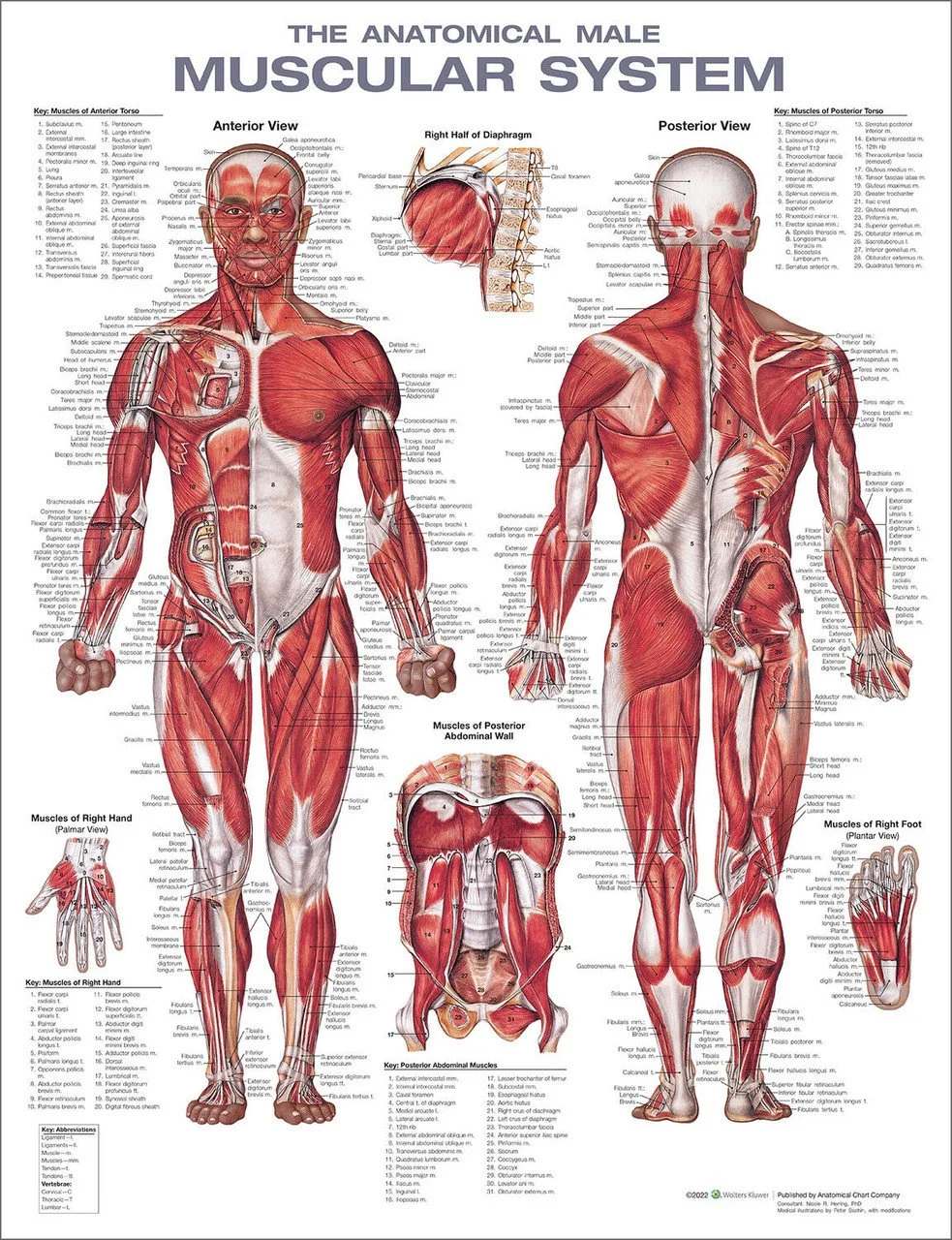
Scientific anatomy is incredible, and completely overwhelming as a starting point.
The Real Mistake: Starting in the Wrong Place
Here’s the part most beginning artists never get told:
Anatomy is not the foundation of figure drawing. It’s one fundamental among many.
Gesture, structure, proportion, perspective, anatomy, they all work together.
But they don’t all deserve the same attention at the same time.
Most beginners never see the full picture.
They assume “Good figure drawing = anatomy knowledge.”
So when anatomy feels impossible, they assume they are the problem.
They’re not. They simply started with too much information, too soon.
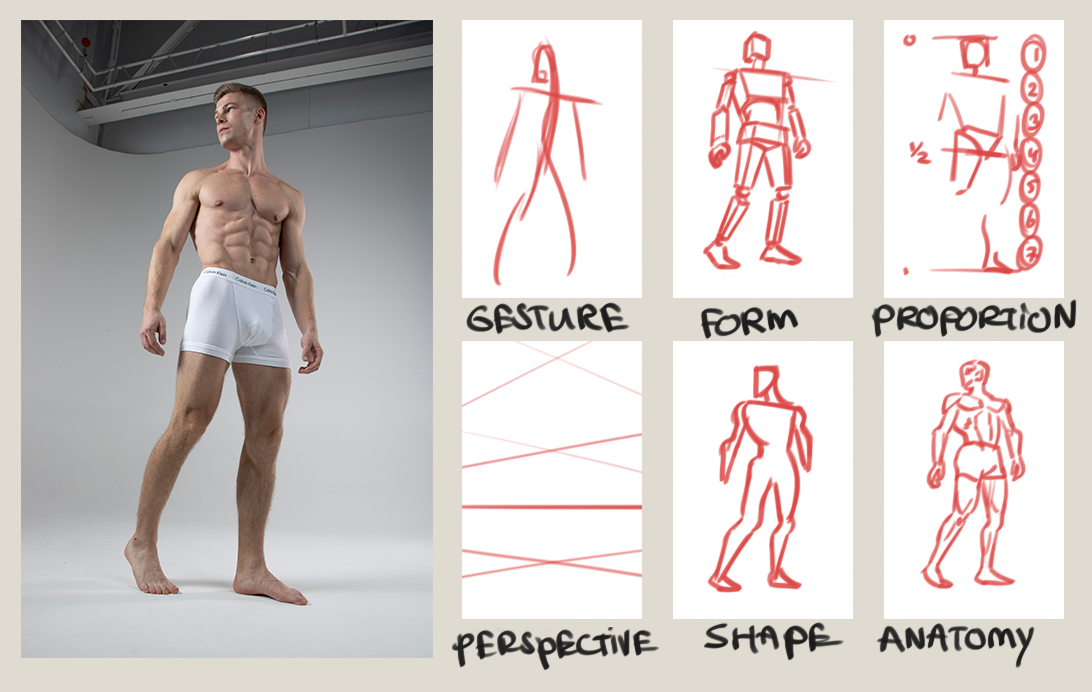
Anatomy matters - but it’s only one part of the system.
Reducing Information Before Adding Skill
If the problem is too much information, then the solution isn’t more studying - it’s less information in the drawing you’re working on.
A realistic human figure contains many layers at once: gesture, balance, proportions, perspective, shape, anatomy. All of that information is present in a real body - which is exactly why starting with realism feels overwhelming.
So instead of trying to manage everything at once, a more workable approach is to temporarily reduce the amount of information in the figure itself.
This is what artists mean when they talk about simplifying the figure.
Not to avoid fundamentals, but to decide which one you’re actually working on.
Simplifying the Figure (Reducing Information on Purpose)
Once you look at drawing through the lens of information, simplification stops being mysterious.
You’re not simplifying because realism is bad. You’re simplifying because a realistic figure contains too many layers at once.
When you draw a simplified figure instead of a realistic one, you’re not avoiding fundamentals.
You’re choosing which fundamental you want to think about right now.
A mannequin is a good example of this.
Compared to a realistic figure:
muscles disappear
surface detail disappears
subtle anatomy disappears
What remains is structure, proportion, and basic balance.
That means the mannequin isn’t realism.
It’s already a reduced version of the figure.
And once you see that, something important becomes clear: if you’re allowed to reduce the figure this much, you’re also allowed to reduce it even further.
Not because you’re a beginner, but because you’re managing complexity on purpose.
A Better Way to Think About Figure Drawing
Think of figure drawing not as a straight path toward more detail, but as levels of abstraction - each one removing information so you can focus on one problem at a time.
Gesture / ribbon - flow, rhythm, intent. No volume, no anatomy.
Simple forms (boxes / cylinders) - orientation in space. How the body tilts, leans, and twists.
Mannequin - proportions and joint relationships. Simplified, but figure-like.
Anatomy (selective) - information added only where it supports the pose.
Rendering / detail - optional, depending on your goal and style.
You don't graduate from gesture forever. You return to it whenever you need clarity. This isn't about choosing a style - it's about choosing how much information you want to handle at once.
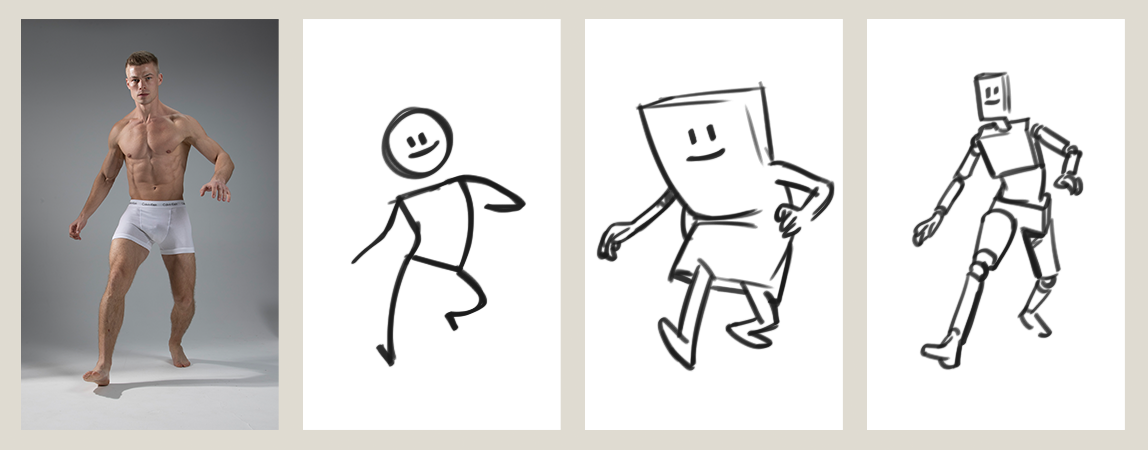
Same pose. Different amounts of information.
Why This Matters for Drawing From Imagination
Drawing from imagination is different from drawing from reference.
When you copy a reference, the pose already exists.
When you draw from imagination, you have to invent it.
That means you need to decide:
where the weight is
how the figure balances
how the body turns in space
Those decisions don’t come from anatomy first.
They come from gesture and structure.
Anatomy helps after the pose works.
It refines. It supports. It adds believability.
But it doesn’t create the pose.
That’s why people who draw confidently from imagination aren’t recalling muscles,
they’re manipulating simple structures they can control.
They’re constructing, not remembering.
How to Practice This
A practice session doesn't need to be complicated. Here's a simple structure you can use anytime:
Find a pose you like
Find the main gesture by drawing the line of action
Translate the pose into a simple 2D stick figure
Increase complexity by turning the limbs into ribbons
Add volume by using a box boy figure
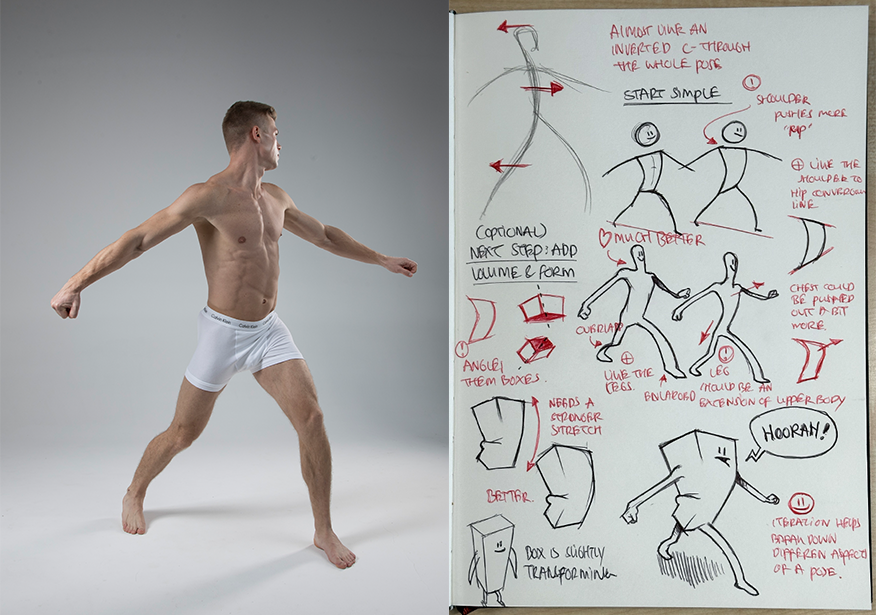
This is what practice actually looks like.
The goal isn't to finish a drawing. The goal is to stay in control of the information.
This is exactly how I structure practice inside the Drawing From Imagination Academy. Reducing information first, then adding complexity gradually, so that posing feels safe, repeatable, and doable. If this article resonates, the course simply gives you more of it.
Control Before Complexity
If drawing figures from imagination feels hard, it's probably not because you lack skill. It's because you're trying to solve too many problems at once.
Reduce the information. Decide what you're actually working on.
Clarity first. Complexity later.
That's not a beginner's shortcut, it's how confident figure drawing actually works.
